
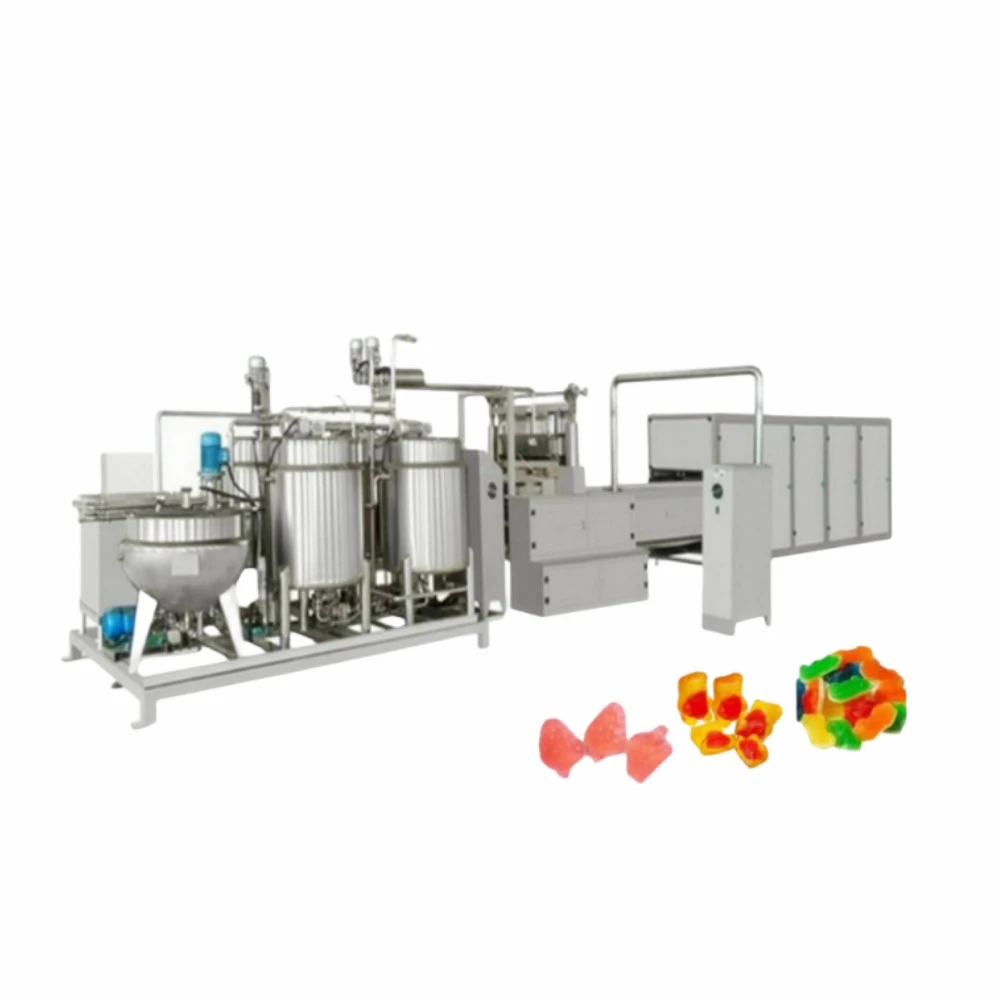
GUMMY CANDY DEPOSITING PRODUCTION LINE
Industrial gummy candy depositing production line with 80-2000 KG/H capacity, PLC control, stainless steel 304/316 and customizable molds for gummy shapes.
View productSpecifying a fully automatic cake production line starts with numbers rather than slogans: planned output, oven energy, floor space and site utilities decide which build works. This guide maps the PD600, PD800 and PD1200 builds of an industrial cake production line — from 200 kg/h up to 500 kg/h — so your team can settle capacity, supply and scope before a quotation is prepared.

Capacity is the first filter. The published range covers three models, each tied to a fixed hourly output and a shared cake weight window, so a forecast of kilograms per hour converts directly into a model choice.
| Model | Output capacity | Cake size | Cake shape | Choose this model when |
|---|---|---|---|---|
| PD600 | 200 kg/h | 10–200 g/pcs | Customized | Planned throughput sits close to 200 kg/h and you want the smallest published capacity step. |
| PD800 | 350 kg/h | 10–200 g/pcs | Customized | Forecast demand runs between the 200 kg/h and 500 kg/h steps and needs headroom for SKU growth. |
| PD1200 | 500 kg/h | 10–200 g/pcs | Customized | You are planning a high-volume single-line operation and 500 kg/h is the published ceiling. |
Area covered runs from 45 × 10 × 3 m to 80 × 20 × 3 m across the range. Ask for the exact envelope that matches the model and oven configuration in your quotation, and confirm building height clearance before committing to a layout.

The whole line, including the outside of the oven, is made of high quality stainless steel, with SUS304 listed as the main material — a detail worth noting for washdown routines and long service life.
Copy these values straight into a plant layout brief or an internal capital request. Every figure below is published for this line.
| Machine model | PD600 / PD800 / PD1200 |
|---|---|
| Output capacity | 200 / 350 / 500 kg/h |
| Cake size | 10–200 grams/pcs |
| Cake shape | Customized via mold plates |
| Main material | SUS304, full-line stainless steel including oven exterior |
| Installed power | Electric oven 300 / 600 / 800 KW · Gas oven 30 / 45 / 60 KW · Diesel oven 30 / 45 / 60 KW |
| Energy source | Electricity, gas, diesel |
| Power supply | 380V / 220V / 50Hz / 60Hz / 3PH |
| Motor brand | ABB / SIEMENS / DELTA |
| Electrical elements | SIEMENS / ABB / SCHNEIDER |
| Pneumatic parts | AIRTAC / FESTO |
| Area covered | 45-60-80 × 10-20 × 3 M |
Oven energy is the second filter, and it is the choice that most affects your facility team. The installed power differs sharply by fuel type, so treat this decision as an infrastructure decision rather than a preference.
Electric heating with no combustion supply line on site, but the highest electrical demand of the three options.
A tunnel oven using advanced gas combustion, with hot air circulating heating across six temperature zones — front, middle, rear, up and down.
Diesel firing for sites where a gas connection is unavailable or impractical, at the same low electrical demand band as gas.
The line is wired for 380V / 220V, 50Hz / 60Hz, three-phase supply. Compressed air is also required for depositor actuation — see the utilities checklist below. For the temperature-control behaviour of the six-zone oven itself, the published six-zone gas-fired tunnel oven article covers the mechanics in detail.
The line runs from batter preparation to a packaging connection point. Each stage has its own task and its own requirements, and knowing them keeps the layout honest before installation day.

Runs: batter preparation for the run schedule.
Needs: recipe control and a steady feed into the depositor.
Runs: automatic filling of a row of cakes, with spacing adjustable for tray sizes, paper cups and multi-row set-ups.
Needs: compressed air for depositor actuation.
Runs: tunnel baking through six temperature zones, with automatic temperature control via a proportional motor driving a butterfly valve.
Needs: the energy supply you selected — electric, gas or diesel.
Runs: cooling conveyors that bring baked product down to a workable temperature.
Needs: conveyor length inside your footprint and airflow in the room.
Runs: an integrated connection point handing product to your packaging stage.
Needs: your wrapper interface agreed early so the hand-off lines up.
The filling machine fills a row of cakes automatically, and if a cake is sensed as missing on the line, the filling needle will not start — so batter is never deposited onto the conveyor belt. That protects material and keeps the line clean through a run.
Hand this list to the people who own the building. Each item is a question your plant engineer will be asked before a quotation can be finalised.
Area covered is 45-60-80 × 10-20 × 3 m across the range. Confirm the exact envelope for your model and oven choice.
The published height figure is 3 m. Check ceiling clearance, ducting and any overhead services before siting the oven.
380V / 220V, 50Hz / 60Hz, 3PH. Match your site voltage and frequency when ordering so the control panel is built correctly.
Electric ovens run 300 / 600 / 800 KW; gas and diesel ovens run 30 / 45 / 60 KW. Have your electrical engineer size the supply.
The depositor is air-actuated, so the line needs a compressed air supply at the pressure and flow confirmed in the quote.
Gas or electric supply for the tunnel oven, depending on configuration — plus ventilation or fuel storage as applicable.
Depositor and conveyor spacing is adjustable for various tray dimensions, paper cups and multi-row configurations — share your formats early.
Agree the packaging connection point and wrapper height so the hand-off from the cooling conveyor lines up on day one.
Different cake formats pull different options into scope. Each scenario below pairs a real production goal with a published fact and the decision it triggers.
A clear scope boundary keeps a project schedule realistic. Three format-enabling units sit on the user's side, and the rest of the line arrives as a connected system.
Mixing equipment, depositing systems, tunnel ovens, cooling conveyors and integrated packaging connections — with the whole line, including the oven exterior, in high-quality stainless steel.
A cup feeder unlocks cup cake; a drying oven and slicing machine unlock sliced cake. These are additionally provided by users, so plan them as separate purchases in the same project.
Standard lead time is usually 30–50 days, depending on customization, oven configuration and optional modules. Operator training is provided onsite or remotely, covering operation, recipe adjustment, sanitation procedures and troubleshooting.
Send your hourly output target, cake weight and shape, preferred oven energy, site voltage and frequency, and available floor area. Customized mold plates for different shapes are part of the configuration conversation, so describe every format you plan to sell.
Keep adjacent product options together for a faster catalog comparison.
Industrial gummy candy depositing production line with 80-2000 KG/H capacity, PLC control, stainless steel 304/316 and customizable molds for gummy shapes.
View product
Manufacture high-quality sweets with this precision depositing line. Optimized for food processing equipment manufacturer standards and food packaging solutions.
View product
Industrial lollipop depositing line with 80-600 KG/H output, PLC control, steam or electromagnetic cooking, SUS304/316 construction and customizable molds.
View productReview the product details, images, and specifications presented on the official product page.
Use the application and use-case information published on the official product page.
Confirm the specifications and options listed for the exact product variant before placing an order.
Check the official product page or ask the supplier about options shown for the selected product.
Use the official contact or inquiry path provided on the site.
Include the product page, intended use, required quantity, and any specifications you need the supplier to review.

